Products

Products

Product list

Withstand voltage test device Live protection appliance Insulation test device Insulation tool Withs

Application Environment of KDJS-8A Intelligent Insulating Gloves/Shoes Withstand Voltage Test Device (simple version)

KDJS-8A intelligent insulating gloves/boots withstand voltage test device is specially designed for preventive test of power system safety tools and widely used in the following scenes:
Power supply bureau, substation and power plant: it is used to regularly test the withstand voltage performance of insulation gloves, insulation boots and other personal protective equipment to ensure the personal safety of operators;
Power maintenance and operation center: carry out batch automatic withstand voltage test for insulating tools and instruments in use every half a year according to the requirements of Preventive Test Procedures for Electric Safety Tools and Instruments;
Safety tools testing station or the third party laboratory: as a standardized testing equipment, it meets the requirements of multi-channel synchronous testing, automatic data recording and tracing;
Electric power construction and engineering unit: carry out quick acceptance or re-inspection on the construction site or warehouse for newly purchased or in-service insulating articles;
Universities and scientific research institutions: used for electrical safety teaching demonstration or insulation material performance research.

The equipment supports dry test (insulating boots) and wet test (insulating gloves) modes, and is equipped with automatic water injection, wireless leakage current monitoring, over-current and over-voltage protection, etc. It can operate stably in the indoor laboratory or on the mobile detection vehicle, adapt to the normal temperature and humidity environment, operate safely and efficiently, and fully meet the "batch, intelligent and compliance" detection requirements of insulation protection articles in the power industry.

Sulfur hexafluoride integrated analyzer SF6 gas purity analyzer Gas integrated tester Micro water me

KDSF-300 SF6 comprehensive tester is a portable high-precision comprehensive analysis instrument specially designed for detecting the gas state of SF6 electrical equipment in the power system, which is applicable to various severe or complex field and laboratory environments. The main application environments include:

HV/EHV Substation
It is used for daily patrol inspection, handover test and state maintenance of SF6 gas-filled equipment such as GIS (gas-insulated metal-enclosed switchgear), GCB (SF6 circuit breaker) and CT/PT (current/voltage transformer).
It can work stably in outdoor or indoor environment of 500kV and above substations and adapt to high temperature, low temperature, humidity change and other climate conditions.
Power plant and power transmission and distribution operation and maintenance site
Periodic gas quality evaluation shall be carried out for SF6 equipment in operation at the step-up station and regional distribution center of the power plant to prevent insulation failure caused by excessive moisture or accumulation of decomposition products.
Power equipment manufacturing and maintenance workshop
SF6 equipment such as transformer and switch cabinet shall be used to verify the gas charging quality, test the tightness and discharge of internal materials before delivery or during the overhaul process, so as to ensure that the products meet the requirements of national standards (such as GB/T 8905 and DL/T 596).
Emergency repair and fault diagnosis scene
When the equipment is abnormal (such as alarm and trip), rush to the site quickly to obtain dew point, purity and decomposition product data synchronously by taking gas once to assist in judging whether there are internal overheating, partial discharge or moisture and improve the fault locating efficiency.
Environmental protection and gas recovery management
In the process of SF6 gas recovery, purification or reuse, it is used to monitor the gas quality, ensure that the recovered gas meets the recharge standard, and help green grid construction and greenhouse gas emission reduction.
Environmental adaptability characteristics:
Wide temperature working range: it can operate normally under the ambient temperature of - 20 ℃ -+50 ℃, meeting the demand of most regions in China in four seasons;
Dust-proof and splash-proof design: good protection grade, suitable for outdoor substation dust, light rain mist and other complex working conditions;
No external air source or power supply required: built-in battery power supply, supporting independent operation on site, especially applicable to GIS bay area without power supply or limited space;
Strong anti-electromagnetic interference capability: the measurement stability can still be guaranteed under strong electromagnetic field environment (such as close to the high-voltage bus in operation).
To sum up, KDSF-300 SF6 comprehensive tester has become an indispensable core testing tool in the whole life cycle management of SF6 equipment of power system due to its multi-function integration, high reliability and strong environmental adaptability.

Material analyzer of transformer

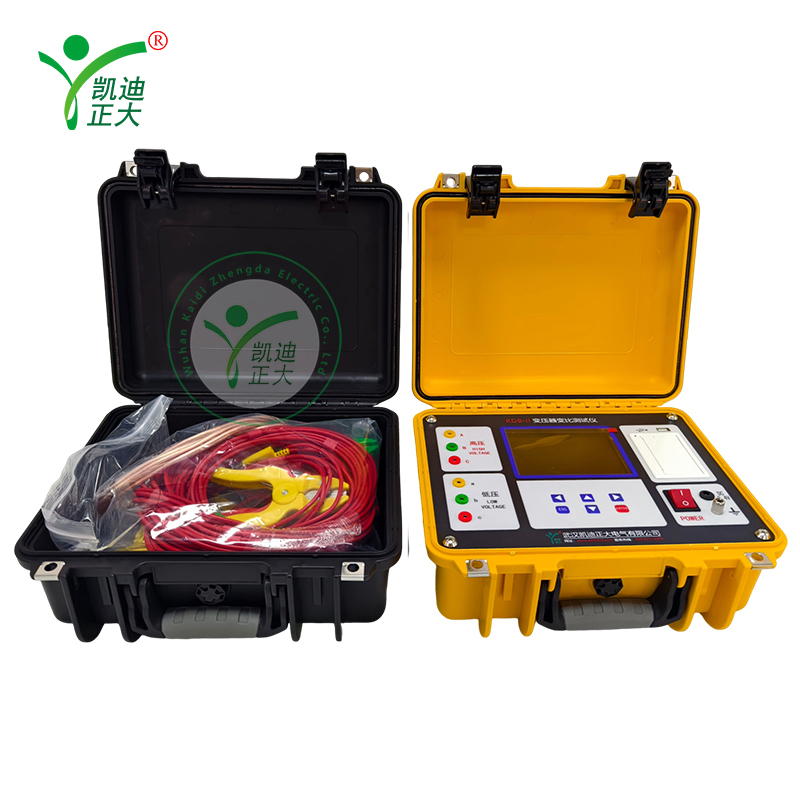
This instrument is a multi-functional measuring instrument, equivalent to four conventional test instruments: active transformer capacity tester+transformer characteristic parameter tester+transformer DC resistance tester+transformer material analyzer. It can accurately measure a series of power frequency parameters such as material, capacity, type, no-load current, no-load loss, load loss, impedance voltage and DC resistance of various transformers.


This product has many advantages such as small size, light weight, high measurement accuracy, good stability and simple operation. It can completely replace the previous method of measuring transformer loss and capacity with multi-meter method. The wiring is simpler, the testing and recording are more convenient, and your work efficiency is greatly improved.


Discharge sphere gap pressure gauge Discharge protection sphere gap Protection sphere gap Disc

Application of ball gap gauge:

When conducting the experiment, connect the ball gap device in parallel with the test sample. The ball gap device itself has a protective resistor of 1 ohm per volt in series. First, adjust the ball gap to 60% of the test voltage (the discharge distance of the ball gap can be checked from the ball gap discharge voltmeter below, Tables 1 and 2). At this time, the test sample should be connected simultaneously. Measure the readings of the test transformer and low-voltage side voltmeter when the ball gap is discharged (take the average of 3-4 times), and then measure the readings of the voltmeter at 70% and 80% of the test voltage in the same way. Use this three-point line value as a curve (mostly a straight line), and then extend this curve (mostly calculated proportionally) to a position 10-15% higher than the required test voltage, as a discharge protection against overvoltage that may occur during the withstand voltage test process.

Experimental discharge ball gap pressure gauge

When conducting the experiment, connect the ball gap device in parallel with the test sample. The ball gap device itself has a protective resistor of 1 ohm per volt in series. First, adjust the ball gap to 60% of the test voltage (the discharge distance of the ball gap can be checked from the ball gap discharge voltmeter below, Tables 1 and 2). At this time, the test sample should be connected simultaneously. Measure the readings of the test transformer and low-voltage side voltmeter when the ball gap is discharged (take the average of 3-4 times), and then measure the readings of the voltmeter at 70% and 80% of the test voltage in the same way. Use this three-point line value as a curve (mostly a straight line), and then extend this curve (mostly calculated proportionally) to a position 10-15% higher than the required test voltage, as a discharge protection against overvoltage that may occur during the withstand voltage test process.

Discharge ball gap pressure gauge

Typical application environment of discharge ball gap pressure gauge (horizontal type)

The discharge ball gap pressure gauge (horizontal type) is mainly used in various professional scenarios that require high-voltage testing, overvoltage protection, and voltage calibration

KDRT638E Handheld thermal imager for temperature measurement

The KDRS638E handheld infrared thermal imager is a high-performance infrared temperature measurement device designed for professional engineers and researchers. It integrates high-resolution thermal imaging, visible light fusion, intelligent analysis, and multi terminal interconnection, and is widely used in high demand application scenarios such as power inspection, industrial automation, building inspection, HVAC, and pipeline system maintenance.

KDRT418E Handheld non focusing infrared thermal imager


Application field
Product development, house inspection, equipment maintenance, power inspection, electrical maintenance

KDRS638E Handheld thermal imaging device

The KDRS638E handheld infrared thermal imager is a high-performance infrared temperature measurement device designed for professional engineers and researchers. It integrates high-resolution thermal imaging, visible light fusion, intelligent analysis, and multi terminal interconnection, and is widely used in high demand application scenarios such as power inspection, industrial automation, building inspection, HVAC, and pipeline system maintenance

KDRM200F Handheld infrared thermal imager

The KDRM200F entry-level handheld infrared thermal imager is designed for scenarios such as power inspection, equipment maintenance, building inspection, and HVAC system diagnosis. Equipped with a 256 × 192 high-resolution infrared core, 40mK thermal sensitivity, and manual focusing lens, it supports temperature measurement over a wide range of -20 ℃~550 ℃ with an accuracy of ± 2 ℃. Equipped with a 3.5-inch touch screen, 2 million visible light camera, laser pointer, and IP54 protection level, it is sturdy and durable, supporting WiFi/USB data transmission, cloud services, and professional analysis software. It can quickly locate thermal faults and generate reports, making it an efficient and reliable on-site inspection assistant for engineers.

KDZD886 Battery Discharge Tester Lead Acid Battery Tester

In modern data centers, uninterruptible power supply (UPS) systems are critical components for ensuring data security and continuous operation. These systems rely on large battery packs to provide emergency power support in case of power outages. Regular maintenance, testing, and performance evaluation are crucial to ensure that these battery packs can operate reliably when needed. The KDZD886 series battery charge and discharge tester is an ideal tool designed for such requirements.

High and low voltage switchgear test bench, switchgear power on test bench, switchgear test power on

Product Overview – KDGK-II High & Low Voltage Switchgear Power-On Test Bench

The KDGK-II High and Low Voltage Switchgear Power-On Test Bench is specifically designed for manufacturers of high and low voltage switchgear to perform comprehensive power-on acceptance tests before product dispatch. It provides a versatile range of adjustable and fixed AC/DC power outputs, enabling efficient and reliable functional verification of switchgear units and significantly improving production line testing efficiency.

Key Features:

  • Integrates a fully controlled three-phase rectifier module, phase-shift triggering circuit, automatic regulation system, and absorption circuit.
  • Employs an intelligent transistor control module that combines complex regulation circuitry, thyristors, and trigger circuits into a compact, unified unit. Output voltage is precisely controlled by adjusting the control signal, which varies the thyristor conduction angle.
  • The triggering circuit, thyristors, and heat-conducting baseplate are mutually insulated, with a dielectric strength exceeding 2,500 V, ensuring safe and reliable operation.
  • Input phase sequence insensitive—simplifies installation and use.
  • Compatible with both resistive and inductive loads.

Technical Specifications:

  • Input Power: Three-phase four-wire AC 380 V
  • Output Capabilities:
    1. Adjustable three-phase four-wire AC voltage: 0–380 V (1 set)
    2. Adjustable three-phase AC current: 0–10 A (1 set)
    3. Adjustable DC operating voltage: 0–260 V (1 set)
    4. Fixed three-phase AC voltage: 100 V (1 set)
    5. Fixed DC outputs: 24 V, 36 V, 110 V, 220 V (1 set)
    6. Fixed three-phase AC output: 380 V (1 set)
    7. Fixed single-phase AC output: 220 V (1 set)
  • Dimensions: 700 × 600 × 1100 mm (W × D × H)

Typical Application Environment:
Ideal for use in switchgear manufacturing workshops, assembly lines, and final inspection areas. The KDGK-II supports full functional testing of common switchgear types (e.g., GGD, GCS, MNS, KYN28) under simulated real-world power conditions. Its robust design, electrical safety features, and flexible power outputs make it a reliable solution for standardized, high-efficiency factory acceptance testing in industrial settings.

Surface interfacial tension meter for petroleum products

Application Environment of KDZL-807 Automatic Interface Tension Tester
1. Applicable industry scenarios
Power industry: used for detecting interfacial tension of liquid media such as transformer oil and insulation oil, evaluating the degree of oil aging and purity, and ensuring the safe operation of power equipment.
Petrochemical industry: detecting surface/interfacial tension of crude oil, lubricating oil, fuel oil, additives, etc., used for oil quality control and formula development.
Pharmaceutical and Bioengineering: Measuring the interfacial properties of drugs, solvents, emulsions, etc. for drug stability, solubility, and formulation process optimization.
Food industry: used for surface tension analysis of liquids such as dairy products, edible oils, beverages, etc., to assist in food composition and quality control.
Universities and research institutions: as the core equipment for teaching and research experiments in physical chemistry, materials science, colloid chemistry, and other fields.
2. Physical environment requirements
Temperature: 10 ° C to 30 ° C (recommended for use in a constant temperature environment of 25 ° C to ensure measurement accuracy)
Humidity: Relative humidity<85% RH (without condensation)
Power supply: AC 220V ± 20%, 50Hz ± 10%, requires stable power supply, it is recommended to use anti surge socket
Installation location: Indoor, well ventilated, no strong electromagnetic interference, no corrosive gases, and no severe vibrations on the experimental table
Space requirement: The device size is 200 × 300 × 330 mm, and there should be reserved space for operation and heat dissipation (recommended tabletop size ≥ 500 × 500 mm)
3. Operation and usage conditions
Operator: Must have basic knowledge of chemistry or instrument operation, and can get started with simple training
Sample requirements: The liquid sample should be clear, free of particle impurities, and avoid contaminating the platinum ring
Calibration and maintenance: Regularly use standard solution (such as pure water) for single point calibration to maintain sensor sensitivity
Data Management: Supports local storage (255 timestamp records) and optional RS232 interface connection to computers, suitable for scenarios requiring data traceability or laboratory information management
 

AC/DC voltage withstand insulation tester

Application environment of KD2675 series AC/DC withstand voltage insulation analyzer
1. Typical application scenarios
The instrument integrates functions such as AC withstand voltage, DC withstand voltage, insulation resistance, and arc detection, and is mainly used in fields that require electrical safety performance testing. Typical scenarios include:

Electronic product manufacturing: voltage/insulation testing of production lines for household appliances, 3C equipment, etc. before leaving the factory;
Medical equipment research and development: safety testing in accordance with standards such as IEC60601 (such as medical instrument quality inspection);
Electrical component quality inspection: incoming inspection and safety certification of suppliers such as cables and circuit boards;
Third party testing institutions: laboratory testing processes for safety certifications such as 3C and CE.
2. Environmental condition requirements
Combining the "installation location" and "usage environment" in the product specifications, the following physical environmental constraints must be met:

Space: Indoor use, altitude ≤ 2000 meters (high-altitude air pressure changes may affect electrical performance stability);
Temperature: 0~40 ℃ (to ensure that the internal components of the equipment work normally within the temperature rise range);
Humidity: The relative humidity at 40 ℃ is 20-90% RH (to avoid insulation failure or electrostatic interference caused by humidity).
3. Adapt to scene characteristics
Automated testing requirements: Supports RS232, PLC/ANDLER interfaces, can be connected to automated production line systems, and achieve efficient batch testing;
High precision R&D/certification scenarios: waveform distortion<2% (resistive load), current measurement resolution up to 0.001mA (AC)/0.1 μ A (DC), meeting the precision testing needs of R&D laboratories and certification agencies;
Areas with high safety requirements: uS level leakage protection response, anti electric shock design, suitable for scenarios such as medical equipment and power systems that require strict testing safety and reliability.
4. Limiting Scenarios
Extreme environments (such as high temperature>40 ℃, high humidity>90% RH, high altitude>2000 meters) may affect testing accuracy or equipment lifespan;
Outdoor direct exposure scenarios (susceptible to dust and moisture interference without protective measures).

KDGK-II high and low voltage switchgear test bench(图文)

The KDGK-II high and low voltage switchgear power on test bench is suitable for the production environment of high and low voltage switchgear manufacturers and is used for power on testing before the switchgear leaves the factory. This device requires a three-phase four wire AC 380V power supply as input and is suitable for testing resistive and inductive loads. The equipment adopts a three-phase rectification module input without phase sequence restrictions. The triggering circuit system, thyristor, and thermal conductive substrate are insulated and isolated from each other, with a dielectric strength greater than 2500V, ensuring safe use. The external dimensions of the equipment are 700 × 600 × 1100mm, suitable for use in dry, non corrosive gas production environments.