22 May-2026
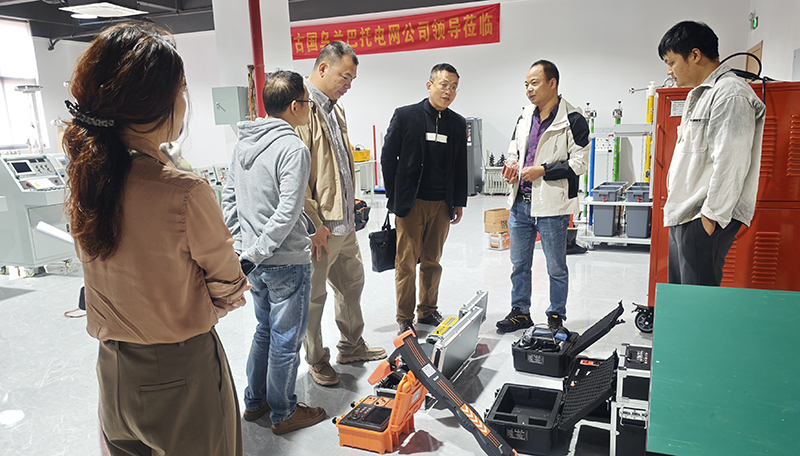
Recently, a delegation from a technology company in Wuhan visited Wuhan Kaide Zhengda Electric Co., Ltd. to conduct an on-site acceptance of their purchased KD-212 Cable Fault Tester and KD-2190 Intelligent Cable Comprehensive Detector. This acceptance aimed to comprehensively evaluate the equipment's performance and gain an in-depth understanding of its functions and practical operation, fully preparing for efficient application in future engineering projects.
During the acceptance session, Kaide Zhengda's technical staff provided a live demonstration of the KD-212 Cable Fault Tester. This device integrates path detection, fault location, and burial depth measurement into a single unit, combining the functions of a path tracer, pinpoint locator, and flash tester to achieve a complete workflow from fault prediction and rough distance measurement to precise pinpointing.
The KD-212 utilizes high-speed data sampling technology with a speed of 100MHz, achieving both a reading resolution and detection blind zone of just 0.3 meters, allowing it to accurately capture near-end faults. It is capable of detecting open circuits, short circuits, poor contacts, high-resistance flashover and leakage faults, as well as various grounding faults. Suitable for power and communication cables of different voltage levels, it boasts a maximum testing distance of 35 kilometers.
In terms of technical principles, the equipment features two built-in modes: the low-voltage pulse method and the high-voltage flashover method. Equipped with a large LCD screen, it presents results in real-time through waveforms and data. Its dual-trace display function allows for the comparison of fault waveforms with normal ones, aiding in the identification of anomalies. For localization, path detection utilizes the principle of electromagnetic induction to trace the cable's route, eliminating interference by adjusting gain and grounding. When used with an A-frame detector, it employs the differential potential method, using red and green indicator lights to guide the user toward the precise fault location. For high-resistance flashover faults, an impulse high voltage can be applied to cause the fault point to discharge, achieving acoustic pinpointing via a high-sensitivity vibration sensor with a positioning accuracy of ±0.5 meters.
Designed with user-friendliness in mind, the receiver features automatic gain adjustment along with dual audio and visual (indicator light) prompts, making it easy to operate. The transmitter supports high-power output and automatic impedance matching, powered by a built-in lithium-ion battery pack that ensures over 8 hours of continuous operation. The instrument can store 100 waveforms, which can be uploaded to a PC via a USB interface for analysis and printing, facilitating the creation of maintenance archives.
Subsequently, the technical team showcased the KD-2190 Intelligent Cable Comprehensive Detector. This instrument is primarily used for pipeline path detection, cable identification, ground fault location, and GPS mapping. It consists of a transmitter, transmitter current clamp, receiver, receiver flexible current clamp, connection test leads, and a stethoscope, with optional accessories such as an A-frame, mapping APP, and RTK.
The KD-2190 supports three signal application methods: direct connection, clamp coupling, and induction, adapting to various on-site conditions. For display, it offers a Classic Positioning Mode (compass, direction, and amplitude indicating the pipeline's left/right position), a Wire Cruise Mode (continuously displaying depth, current, and relative pipeline position in 360°), and a Signal Curve Mode (locating cables based on historical signal strength changes). With strong anti-interference capabilities, its narrow receiving bandwidth combined with digital processing effectively suppresses power frequency and harmonic interference from adjacent operating cables and pipelines. It features a depth measurement range of 0 to 20 meters, with a horizontal position accuracy of ±5% for burial depths within 3 meters, and ±10% for depths between 3 and 20 meters.
Cable identification supports both de-energized and live methods. De-energized identification uses a "core wire-to-earth" connection, while live identification is applicable to three-core armored cables using clamp coupling. The intelligent identification process includes near-end calibration and far-end identification, where the instrument automatically compares current amplitude and direction to display the target cable's identification result, significantly improving the efficiency of distinguishing between multiple cables.
The delegation members affirmed the functional specifications of both the KD-212 and KD-2190. Technical personnel from both sides engaged in in-depth discussions regarding operational key points under different working conditions, scenario selection, and daily maintenance. Kaide Zhengda's technicians emphasized safety precautions, such as preventing electric shock, ensuring correct grounding, and strictly prohibiting the connection of de-energized cables to live ones during identification, ensuring the delegation could operate the equipment safely and standardizedly.
Following the acceptance, both parties agreed that the combined use of the KD-212 and KD-2190 achieves a complete closed-loop workflow from rough distance measurement to precise fault location, providing users with a comprehensive cable testing solution. The successful completion of this equipment acceptance not only strengthens the cooperative relationship between Wuhan Kaide Zhengda Electric Co., Ltd. and the Wuhan technology company but also injects new momentum into Kaide Zhengda's continuous dedication to the power testing equipment sector and its ongoing improvement of products and services.