21 Jul-2026
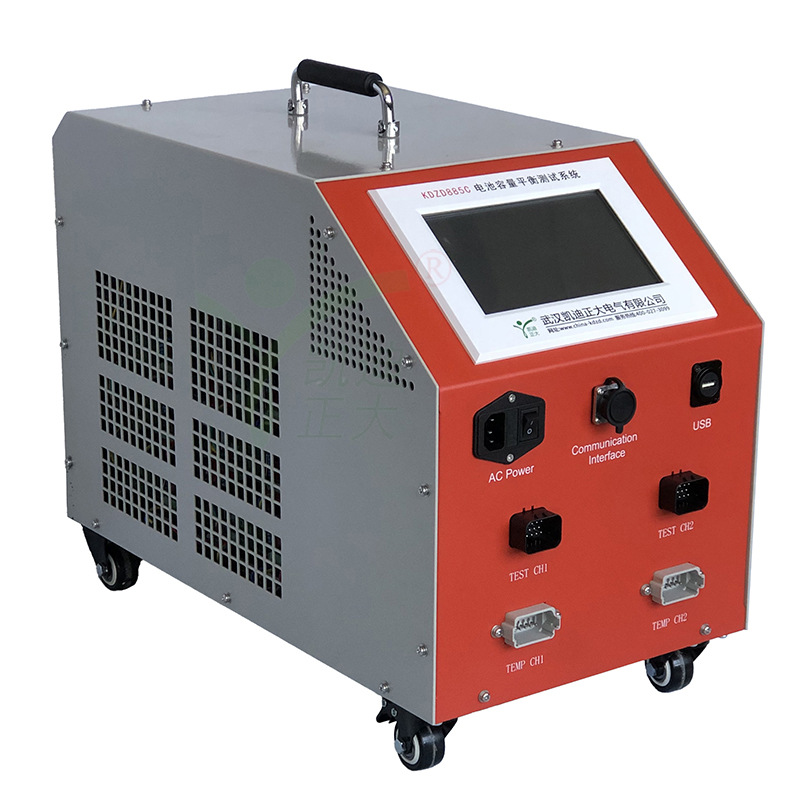
In the wave of deep integration within the global new energy industry, lithium batteries serve as the core energy storage medium. Their manufacturing quality, system safety, and operational efficiency directly determine whether products can overcome international trade barriers and maintain competitiveness in complex application scenarios. Incorporating testing equipment that complies with authoritative international standards into battery lifecycle management has become an industry consensus. Leveraging superior technical specifications, the KDZD885C Lithium Battery Charge/Discharge and Equalization Maintenance Tester aligns seamlessly with International Electrotechnical Commission (IEC) and international power industry standards, providing robust technical support across three core scenarios: battery manufacturing quality control, energy storage station operation and maintenance (O&M), and new energy vehicle (NEV) fleet maintenance.
I. Battery Manufacturing Quality Control: Consolidating the Manufacturing Foundation and Ensuring Factory-Exit Performance and Global Mutual Recognition
In the quality control phase of batteries targeting international markets, there are stringent and uniform requirements for the measurement accuracy of core cell parameters. The KDZD885C achieves a voltage measurement accuracy of ±0.1%FS±1mV and a current measurement accuracy of ±1%FS+0.1A. This high-precision performance fully complies with the accuracy requirements for professional testing equipment stipulated in
Clause 6.2 of IEC 61960-1:2017 (Secondary cells and batteries containing alkaline or other non-acid electrolytes - Secondary lithium cells and batteries for portable applications) and
Clause 5.2 of IEC 62660-1:2018 (Secondary lithium-ion cells for the propulsion of electric road vehicles). The equipment can precisely capture minor voltage fluctuations during the charge and discharge processes of cells, effectively eliminating substandard products and ensuring high consistency in factory-exit battery packs.
Regarding safety management, the KDZD885C features multiple host protection mechanisms—including input/output overcurrent, overvoltage, undervoltage, over-temperature, and reverse polarity protection—along with real-time cell temperature monitoring. This strictly adheres to
Clause 7.3 of IEC 62619:2022 (Secondary cells and batteries containing alkaline or other non-acid electrolytes - Safety requirements for secondary lithium cells and batteries, for use in industrial applications - Protection system verification). During the quality control phase, the equipment can simulate extreme operating conditions to verify the protection logic of the Battery Management System (BMS), effectively identifying and intercepting potential thermal runaway risks, thereby significantly enhancing the safety margin of battery products and facilitating international certifications.
II. Energy Storage Station O&M: Safeguarding the New Power System and Ensuring Grid-Connection Safety and Operational Efficiency
As the core hub of the new power system, energy storage stations impose extremely high consistency requirements on battery packs. During routine station inspections, the testing accuracy of the KDZD885C fully complies with
Clause 5.3 of IEC 62933-4-1:2022 (Performance testing methods for energy storage systems). The equipment can accurately capture the voltage deviation of individual cells and perform active equalization through 24 independent channels, effectively mitigating the "barrel effect." This ensures that the charge/discharge efficiency of the energy storage system meets stringent grid peak-shaving and frequency-regulation requirements.
Addressing the critical safety concerns of energy storage stations, the over-temperature protection and real-time cell temperature monitoring functions of the KDZD885C strictly follow
Clause 8.1 of IEC 62619:2022 (Thermal runaway protection and BMS functional verification for industrial secondary lithium cells and batteries). Through deep charge/discharge cycling, the equipment can verify the sensitivity of BMS protection logic under varying temperatures, proactively identifying and isolating degraded cells at risk of thermal runaway. Furthermore, its 7-inch touchscreen and data export capabilities align with
Clause 6.2 of IEC 62933-5-2:2023 (O&M procedures for energy storage systems), significantly reducing offline testing time for energy storage modules and lowering total lifecycle O&M costs.
III. NEV Fleet Maintenance: Empowering Efficient Commercial Fleet Operations and Asset Value Retention
In the commercial new energy vehicle sector, the degradation and inconsistency of power batteries directly impact vehicle range and operational efficiency. High-frequency use in commercial fleets often exacerbates cell voltage deviations. The testing accuracy of the KDZD885C complies with
Clause 5.4 of IEC 62660-2:2018 (Reliability and capacity testing procedures for secondary lithium-ion cells for electric road vehicles). During maintenance, the equipment can accurately assess the capacity of degraded battery packs and utilize a "high-voltage discharge, low-voltage charge" equalization mode to rapidly correct individual cell voltage deviations. This restores overall pack capacity and avoids unnecessary full-pack replacements.
Given the high reliance of commercial vehicles on fast charging, which accelerates battery degradation, the KDZD885C is equipped with comprehensive overcurrent, overvoltage, and reverse polarity protections, strictly adhering to
Clause 6.1 of IEC 62660-3:2021 (Safety testing requirements for EV lithium-ion batteries - Overcharge and short-circuit protection verification). The equipment can simulate high-current operating conditions to verify the BMS's thermal management response and disconnect protection logic during fast charging. Simultaneously, with built-in high-capacity storage and data upload support, it complies with
Clause 7.2 of IEC 62660-1:2018 (Lifecycle data recording and traceability specifications for power batteries). Complete charge/discharge curves and pre/post-equalization voltage deviations are recorded, providing authoritative data substantiation for fleet maintenance and used NEV residual value assessments.
In summary, characterized by high precision, robust safety, and intelligent functionality, the KDZD885C Lithium Battery Charge/Discharge and Equalization Maintenance Tester plays an irreplaceable role in battery lifecycle management. It is not only a vital instrument for executing international power industry testing standards but also a crucial technological enabler for the global new energy industry's transition toward high-quality, large-scale, and internationalized development.