25 Nov-2026
1. Incident Review: Sudden Trip at Jianghan Prison, Unknown Cable Path
Yesterday (November 24), the KDZD technical department received an urgent request from
Jianghan Prison, Hubei Province: the medium and low voltage power distribution system of the facility suddenly tripped, and multiple outgoing lines could not be re-energized. Preliminary assessment indicated a cable body fault.
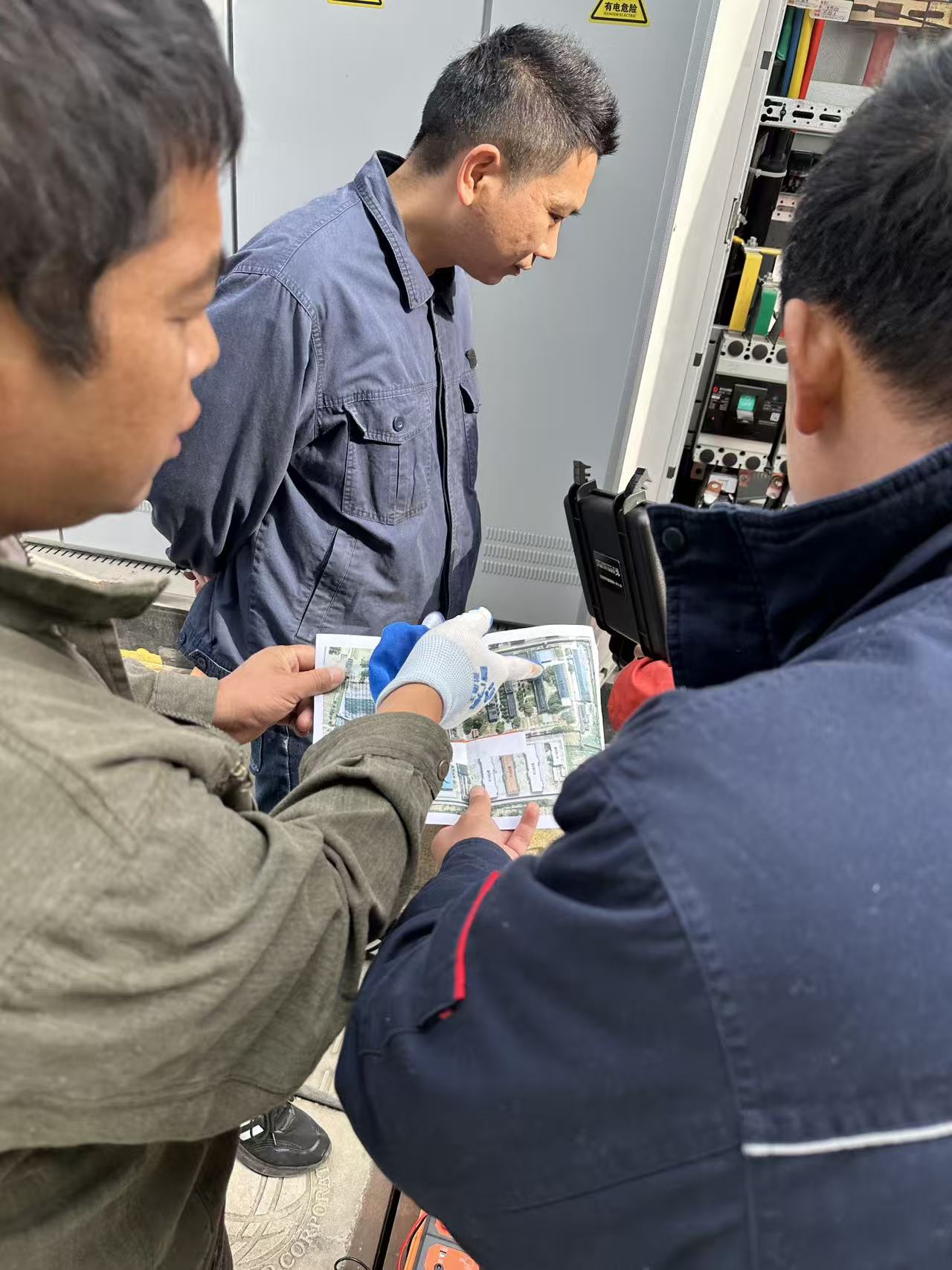
Upon receiving the notice, two senior KDZD engineers rushed to the site, equipped with the
KD-2190 Underground Pipeline Locator (Cable Path Finder), the
A-Frame (Step Voltage Locator) and the
KD-210 High Voltage Flashover Generator.
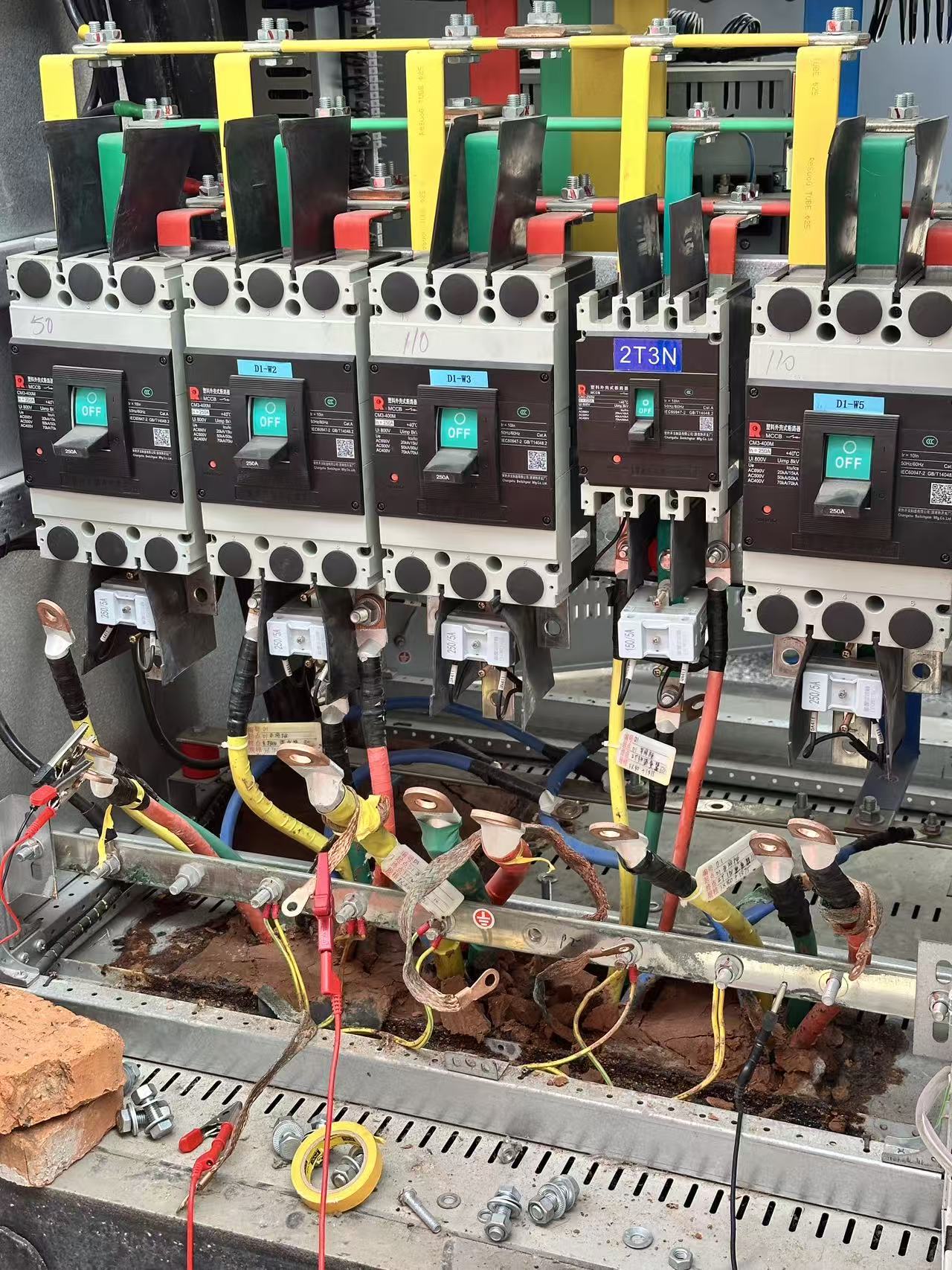
As seen in the on-site photos:
- Multiple CM3-400M molded case circuit breakers inside the distribution cabinet were in the OFF position, with some outgoing terminals disconnected and test wires temporarily attached.
- There was obvious water accumulation and mud in the cable trench and at the bottom of the cabinet, indicating a high risk of insulation moisture.
- Engineers first disconnected both ends of the faulty cable to ensure safety and isolate the test section, then began the systematic troubleshooting process.
2. Troubleshooting Strategy: How to Find Medium and Low Voltage Cable Faults?
Cable fault location is not “blind digging” but a standardized process. For this site at Jianghan Prison, our engineers followed a
four-step method combining path tracing, step voltage pinpointing and flashover verification:
Step 1: Disconnect Both Ends & Preliminary CheckFirst, both ends of the faulty cable were completely disconnected to isolate it from the live system. This ensures operator safety and prevents parallel paths from affecting test results.
Step 2: Quick Path Tracing with KD-2190 Pipeline LocatorConnect the transmitter to one end of the cable to inject a specific frequency locating signal; engineers then use the handheld
KD-2190 receiver to trace along the ground.
| KD-2190 Advantage: Features ultra-strong signal reception capabilities and multi-frequency selection. Even in complex environments with dense metal pipelines and electromagnetic interference, it can clearly lock onto the target cable's route and burial depth, avoiding “digging the wrong path or pipe.” |
Step 3: Fast Fault Pinpointing with A-Frame (Step Voltage Method)Once the path was confirmed, the
A-Frame was deployed along the traced route. The A-Frame detects the step voltage difference on the ground surface caused by the fault current, allowing engineers to quickly narrow down the fault location to a very small area — typically within 1 meter.
Step 4: Verification with KD-210 Flashover MethodTo double-check and confirm the exact fault point, the
KD-210 High Voltage Flashover Generator was used. By applying a high voltage pulse to the cable, the flashover method creates a discharge at the fault point, which can be detected acoustically or electromagnetically. This
verification step ensured that the location identified by the A-Frame was indeed the correct fault point,
greatly accelerating the overall cable fault detection process.
3. On-Site Results: Fast, Accurate, Verified
Thanks to the systematic combination of the
KD-2190 Pipeline Locator,
A-Frame and
KD-210 Flashover Method, the KDZD technical team achieved the following upon arriving at the site:
✅ Quickly disconnected both ends of the faulty cable and completed safety isolation;
✅
Used the KD-2190 to trace the actual cable route in one go, even with limited or inaccurate site information;✅
Deployed the A-Frame along the traced path to rapidly narrow down the fault point;✅
Verified the location using the KD-210 flashover method, confirming the fault point with high confidence;✅ Excavation confirmed the fault location highly matched the instrument's indication.
The entire troubleshooting process
eliminated the need for large-scale blind excavation, significantly reducing downtime and earning recognition from the facility's electrical management team at Jianghan Prison.
4. Key Equipment Specifications
KD-2190 Underground Pipeline Locator
| Item |
Specifications |
| Detection Method |
Electromagnetic Induction (Direct Connection, Clamp, Induction) |
| Detection Depth |
Up to 5~6m (depending on pipe diameter and soil conditions) |
| Positioning Accuracy |
Horizontal error ≤±3% (burial depth), Depth error ≤±5% |
| Transmission Frequencies |
Multiple selectable (e.g., 512Hz, 8kHz, 33kHz, 83kHz, etc.) |
| Reception Frequencies |
Supports multi-frequency synchronous reception, strong anti-interference |
| Display |
Color LCD screen, dual display with digital + bar graph |
| Signal Strength |
Ultra-strong signal processing, clear path peaks and distinct valleys |
| Power Supply |
Built-in lithium battery, supports long-term field operations |
| Protection Rating |
Engineering chassis, shockproof and dustproof, adapts to complex sites |
A-Frame (Step Voltage Locator)
| Item |
Specifications |
| Detection Principle |
Step voltage method for precise fault pinpointing |
| Pinpointing Accuracy |
Typically within 1m, can be refined to centimeter level |
| Compatibility |
Works with cable fault locators and high voltage generators |
| Portability |
Lightweight, easy to deploy along cable path |
KD-210 High Voltage Flashover Generator
| Item |
Specifications |
| Testing Method |
Flashover method (impulse discharge) |
| Output Voltage |
Adjustable high voltage output for fault breakdown |
| Application |
Verification of fault points, high resistance fault detection |
| Display |
Analog meters for voltage and current monitoring |
| Protection |
Overload and short circuit protection |
5. Frequently Asked Questions (FAQ)
Q1: Why is it necessary to disconnect both ends of the cable before testing?A: Disconnecting both ends isolates the faulty cable from the rest of the power system. This ensures operator safety, prevents parallel paths or connected equipment from interfering with test signals, and guarantees accurate measurement results.
Q2: Why use both the A-Frame and the KD-210 flashover method?A: The A-Frame (step voltage method) is fast and effective for initial pinpointing along a known path. The KD-210 flashover method provides an independent verification by creating a detectable discharge at the fault point. Using both methods together
cross-checks the result and significantly speeds up the overall detection process by eliminating uncertainty.
Q3: How deep can the KD-2190 detect cables?A: Under standard configuration, the maximum detection depth can reach 5~6m, meeting the cable detection needs of most industrial parks, campuses, and municipal networks.
Q4: What if the on-site interference is high and the signal is weak?A: The KD-2190 features multi-frequency selection and strong signal processing capabilities. Users can switch frequencies to avoid interference, ensuring clear and stable path tracing.
Q5: Can these instruments be used for both medium and low voltage cables?A: Yes. The KD-2190 is used for path tracing regardless of voltage class (after de-energization and disconnection). The A-Frame and KD-210 flashover method are applicable to both medium and low voltage cable fault pinpointing and verification.
Q6: Can it be used without prior experience?A: The KD-2190 has a simple user interface and supports automatic peak/valley positioning. KDZD also provides
on-site debugging and technical training to ensure users can operate it independently.
KDZD – Specialized in Cable Fault Detection and Power Testing Equipment
|