26 Aug-2026
In the operation and maintenance of power systems, single-phase ground faults have always been regarded as the most stubborn "invisible killers." They not only cause abnormal grid voltages and threaten equipment insulation safety but also plunge troubleshooting efforts into a "needle in a haystack" dilemma due to the hidden nature of the fault points and complex environmental conditions.
Recently, a lightning-induced fault on an international cross-border grid interconnection line has once again sounded the alarm. Facing this global technical challenge, how can we shift from traditional "trial-and-error switching" to "precision targeting"? This article analyzes the pain points of ground fault detection through real-world international cases and explains in detail how we utilize the
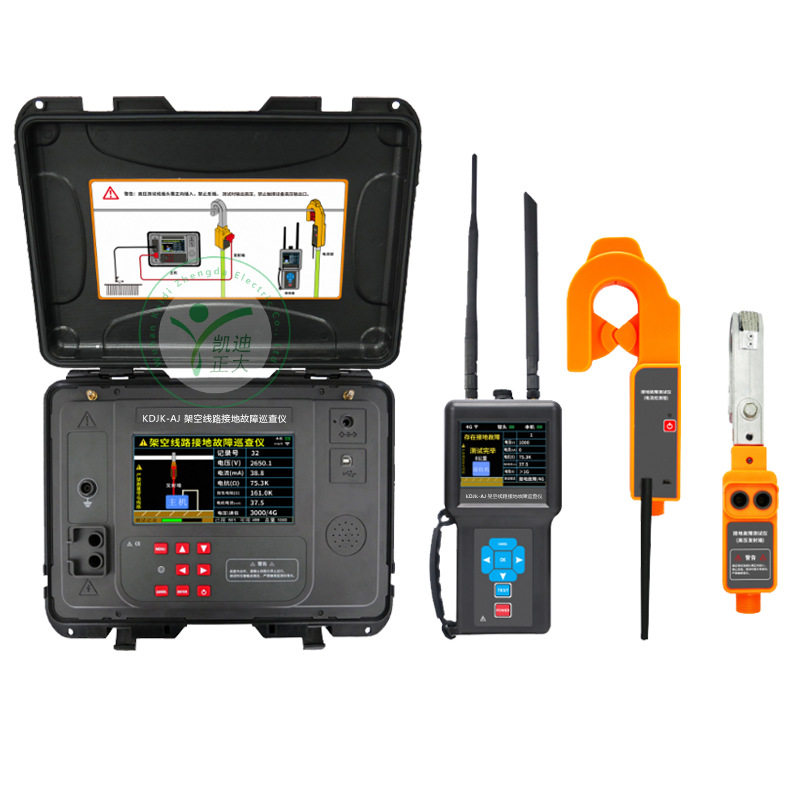
KDJK-10AJ Overhead Line Ground Fault Patrol Instrument to provide a "Chinese solution" to this industry-wide challenge.
I. Lessons from Abroad: The "Ground Fault Nightmares" Faced by International Grids
Ground faults are not unique to China; power grid maintenance personnel worldwide are battling them. However, due to the lack of efficient locating methods, several countries have experienced severe consequences caused by delayed fault detection.
Case 1: The "Aftermath of a Lightning Strike" on Cross-Border Interconnection LinesDuring a fault on an international cross-border grid interconnection line, a severe lightning strike damaged the electrical insulation, triggering a complex single-phase ground fault. Because the line spanned diverse geographical environments and involved different national power facility standards, the repair team faced enormous challenges.
In the early stages of the fault, the inability to quickly pinpoint the exact location (e.g., whether it was a broken insulator or a fallen conductor) forced the repair personnel to conduct extensive manual patrols along the line. This inefficient troubleshooting method prolonged repair times, disrupted power flow distribution, and forced dispatch centers to perform emergency grid reconfiguration, transferring overloaded line currents to other lines and significantly increasing grid operational risks.
Case 2: The "Hidden Menace" in Harsh ClimatesDuring a severe snowstorm in a certain European region, line icing caused a serious ground fault. Unlike obvious line breaks, this fault often manifested as "high-resistance grounding" or "intermittent arcing." Due to the lack of precision instruments capable of detecting high-resistance and hidden faults, local maintenance personnel spent several days in the snow-covered wilderness before finding the fault point. During this time, the power supply reliability for critical users, such as hospitals and transportation hubs, was severely tested.
These real-world cases all point to one truth:
When a ground fault occurs, whoever can find the "point" fastest holds the initiative in grid safety.
II. Directly Addressing Pain Points: Why Do Traditional Methods Always Lag Behind?
Facing the dilemmas seen in the international cases above, traditional domestic troubleshooting methods also have their limitations.
For a long time, the "trial-and-error switching method" has been the primary means of fault detection. Maintenance personnel sequentially trip circuit breakers to observe whether the ground fault phenomenon disappears. This method is not only inefficient but also carries the risk of short-term power outages. For overhead lines spanning dozens of kilometers, relying on visual inspections or simple megohmmeter measurements is often futile when dealing with hidden faults like transition-resistance grounding or surge arrester breakdowns.
Based on profound insights into these domestic and international pain points, we have developed and launched the
KDJK-10AJ Overhead Line Ground Fault Patrol Instrument. This is not just an upgrade of tools, but a revolution in operational modes.
III. Technological Breakthrough: How the KDJK-10AJ "Nails Down" the Fault with Precision
Addressing the issues of lightning-induced insulation damage and high-resistance grounding seen in international cases, the KDJK-10AJ adopts a completely new "signal injection + dual-mode communication" solution, transforming fault detection from "passive guessing" to "active locating."
1. High-Voltage Signal Injection: Breaking the "High-Resistance" BarrierThe insulation damage caused by lightning strikes mentioned in international cases often involves high transition resistance. The host unit of the KDJK-10AJ can inject
AC 3000V and 8000V high-voltage signals into the line, with an output current of ≤100mA.
This powerful signal penetration enables the equipment to detect not only metallic grounding but also accurately capture hidden faults such as
arcing grounding, transition-resistance grounding, insulator breakdown, and surge arrester breakdown. It can even handle direct short circuits of 0Ω with ease.
2. 0.2-Meter Level Precision: Bidding Farewell to "Blind Patrols"In cross-border grid emergency repairs, the most time-consuming part is "finding the way." By using a current detection clamp to measure pulse current and impedance, combined with host analysis, the KDJK-10AJ can control the fault locating precision to
≤0.2m.
This means maintenance personnel no longer need to conduct large-scale patrols as seen in international cases; they can walk directly to the fault point. The equipment can accurately determine the fault direction, with the receiver providing intuitive guidance via voice prompts and screen displays, telling the operator: "The fault is ahead."
3. 4G/LoRa Dual-Mode Communication: Breaking Geographical LimitsIn harsh climates and complex terrains (such as heavy snow or mountainous areas), personnel often struggle to stay close to the host unit. The KDJK-10AJ utilizes advanced
4G and LoRa dual-mode communication technology.
- Host and Receiver: Communicate via 4G/LoRa to control signal output and return results.
- Detection Clamp and Receiver: Transmit signals via LoRa communication.
This design allows a communication distance of up to 5 kilometers in open areas. Operators can monitor in real-time from safe zones kilometers away without frequent travel in the wilderness, greatly reducing operational intensity in harsh environments like European snowstorms.
IV. Practical Demonstration: How Would We Handle It with the KDJK-10AJ?
If the KDJK-10AJ were applied to the international fault scenarios mentioned above, our handling process would be highly efficient and standardized:
Step 1: Rapid Deployment and MountingAfter the line is shut down, we arrive at the scene with the complete set of equipment (weighing about 25kg, including the host, transmitter, receiver, etc.). Using an insulated rod, the high-voltage transmitter is mounted onto the line. Even for wires with insulated outer sheaths, there is no need to strip the insulation; simply hang it on the voltage detector ring to achieve truly non-destructive testing.
Step 2: Intelligent Analysis and Directional GuidanceTurn on the host; the 7-inch color screen clearly displays the line status. After injecting the high-voltage signal, the operator patrols along the line with the handheld receiver. When passing near the fault point, the receiver will immediately issue a voice prompt: "Fault direction ahead, ground resistance XX ohms."
Step 3: Precise RepairGuided by the ≤0.2m precision, we quickly locate the lightning-damaged insulator or broken surge arrester. After replacing the damaged component, we retest to confirm the fault is eliminated and restore power. The entire process may take only a few hours, instead of days.
V. Conclusion: Safeguarding Grid Safety with "Intelligent Manufacturing from China"
From international cross-border line faults to domestic daily maintenance, ground fault detection remains a mandatory course for power workers. With its hardcore specifications of
8000V high-voltage output, 0.2m high-precision locating, and 4G/LoRa remote communication, the KDJK-10AJ Overhead Line Ground Fault Patrol Instrument has successfully solved the traditional problems of "inaccurate measurement, short range, and slow speed."
It is suitable for both bare conductors and cables with insulated outer sheaths; it can detect metallic grounding as well as conquer high-resistance and hidden faults. In the future of grid operation and maintenance, we will continue to use technology as our wings to make fault detection simple and efficient, contributing wisdom and strength to the safe and stable operation of global power grids.